
What Is a Binary Tree?

A binary tree is a data structure in which each node holds a value and points to at most two children, usually called the left child and the right child. It organizes data in a branching, hierarchical shape rather than a flat list, which makes many search and sort operations faster than working through items one by one.
Every binary tree starts from a single node called the root. From there, each node can branch into a left subtree and a right subtree, and those subtrees are themselves binary trees, built from the same simple rule applied over and over.
How a binary tree works
A binary tree grows one node at a time. When you insert a new value, the tree compares it against existing nodes and decides whether it belongs to the left or the right of each node it passes, following a rule set by whichever binary tree variant you are building. In a binary search tree, for example, smaller values move left and larger values move right, so the structure stays organized as it grows.
Reading a binary tree usually means traversing it: visiting nodes in a defined order such as in-order, pre-order, or post-order. Each traversal style serves a different purpose, from printing values in sorted order to rebuilding the tree from scratch.
Key parts of a binary tree
- Root: the single top node every path starts from.
- Node: a unit holding a value plus references to its children.
- Left and right child: the two possible branches from any node.
- Leaf: a node with no children, marking the end of a branch.
- Height: the number of edges from the root to the farthest leaf, a key measure of how balanced the tree is.
These pieces combine in simple, repeatable ways, which is part of why binary trees are one of the first structures taught after arrays and linked lists.
Why binary trees matter
Binary trees matter because they turn operations that would otherwise scan an entire list into operations that skip over large portions of data at once. In a balanced binary tree, finding, inserting, or removing a value typically takes a number of steps proportional to the height of the tree rather than the total count of items, so performance holds up well as the data set grows.
They also give programs a natural way to represent hierarchy. File systems, decision logic, and parsed expressions all map cleanly onto a branching structure, which is part of why binary trees show up across so many areas of computing.
Common uses
Binary search trees back many in-memory lookup structures, letting an application find a record quickly without scanning every entry. Balanced variants such as AVL trees and red-black trees keep that speed steady even after many insertions and deletions, which is why they sit underneath several database indexes and language libraries.
Beyond search, binary trees appear in heaps used for priority queues, in expression trees used to parse formulas and code, and in decision trees used for classification. Each use case borrows the same core shape, a root with up to two children per node, and adapts the rules around it.
Where to start
The most direct way to learn binary trees is to build a small one by hand: define a node with a value and two child references, write an insert function, then write a traversal function and watch it print values in order. From there, practice the classic operations such as searching for a value, finding the minimum or maximum, and deleting a node while keeping the structure valid.
Once the basics feel steady, move on to balanced trees and compare how insertion and lookup behave as the data grows, since that comparison is what makes the value of balancing concrete rather than abstract.
Where Sticklight fits
Sticklight is a vibe-coding platform for professional web creators, built to turn a plain-language prompt into a production-ready website, app, dashboard, CMS, or tool. Understanding a foundational structure like a binary tree helps when you want to reason about how an application organizes and searches its data, whether you are describing that logic in a prompt or reviewing the code Sticklight produces.
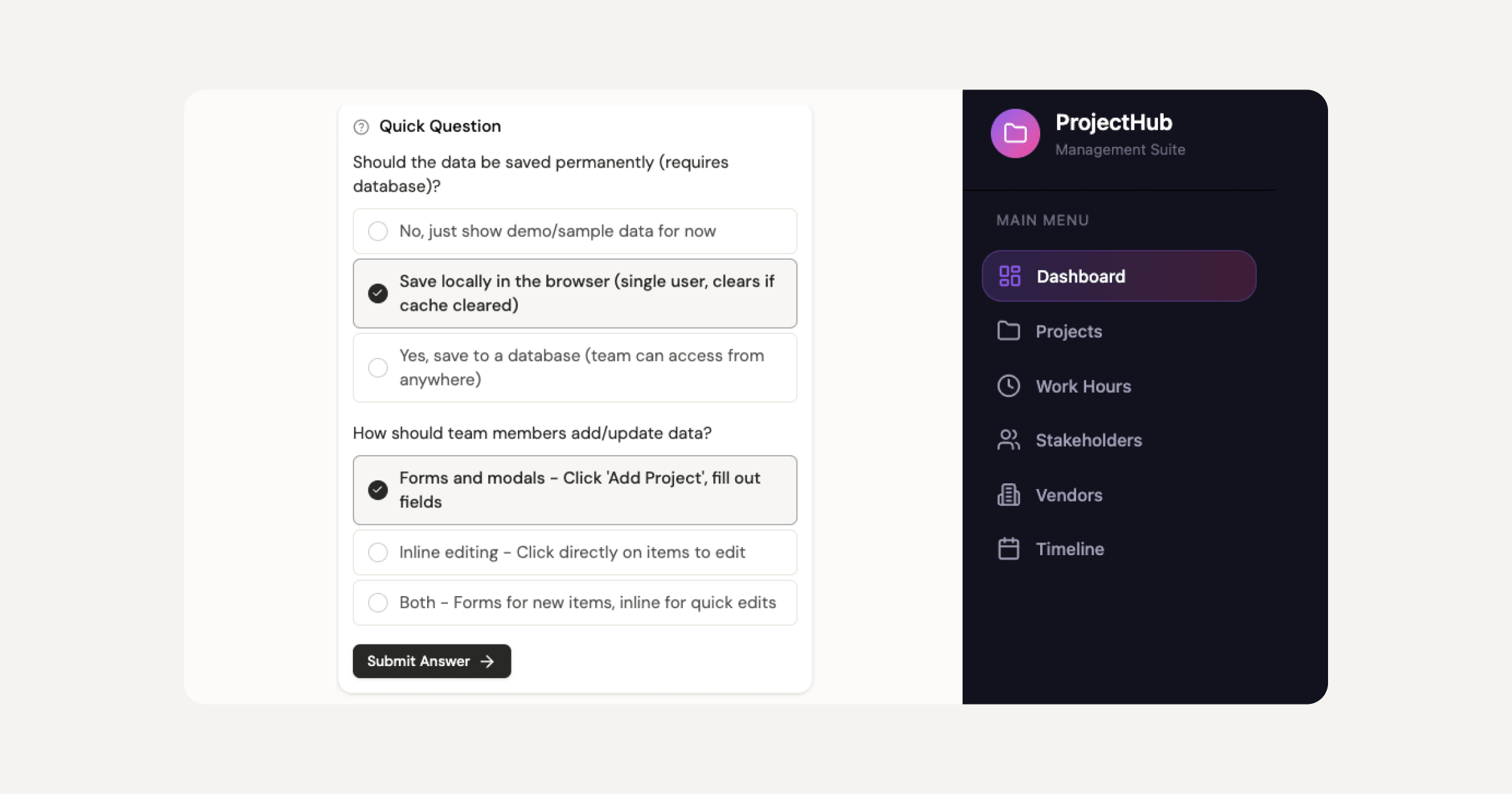
Sticklight is built for more than websites. It is aimed at creators who want one platform to go from an idea to a working, full-stack product, spanning the interface, the logic, and the data behind it. WordPress and Elementor remain solid, proven ways to build and extend a site, and Sticklight adds a path for teams who want to move straight from a prompt into that full-stack result.
Frequently asked questions
What is the difference between a binary tree and a binary search tree?
A binary tree only requires that each node have at most two children, while a binary search tree adds an ordering rule so that smaller values sit to the left of a node and larger values sit to the right.
How many children can a node in a binary tree have?
A node in a binary tree can have zero, one, or two children, and a node with no children is called a leaf.
What does it mean for a binary tree to be balanced?
A balanced binary tree keeps the height of its left and right subtrees close to equal at every node, which keeps searches, insertions, and deletions fast as the tree grows.
What is a traversal in a binary tree?
A traversal is a defined order for visiting every node in a binary tree, such as in-order, pre-order, or post-order, and each order suits a different task.
Where are binary trees used in real software?
Binary trees underpin many search structures, priority queues built as heaps, and expression trees used to parse formulas or code, among other applications.
Built by the Elementor team. Powered by Claude.
Let it glow.
