
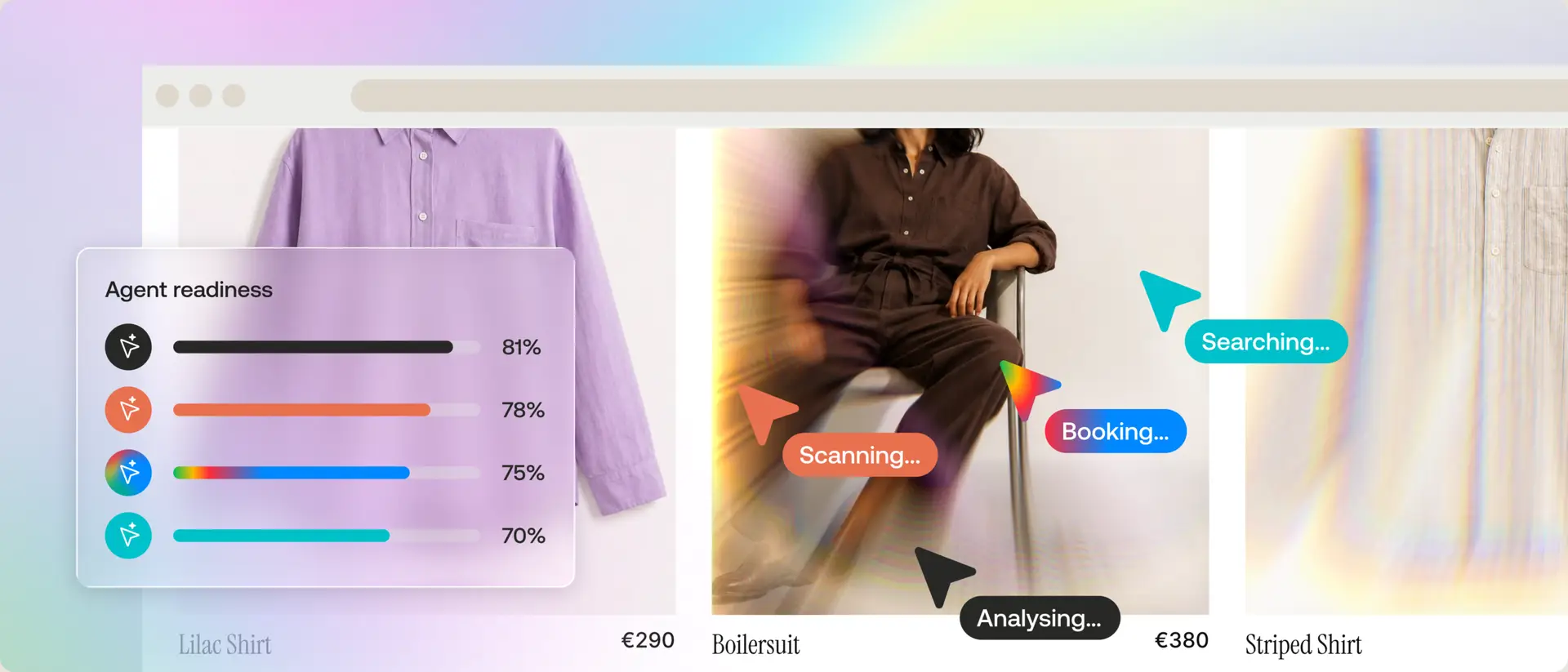
What is an agent-ready website? And how to check your client sites

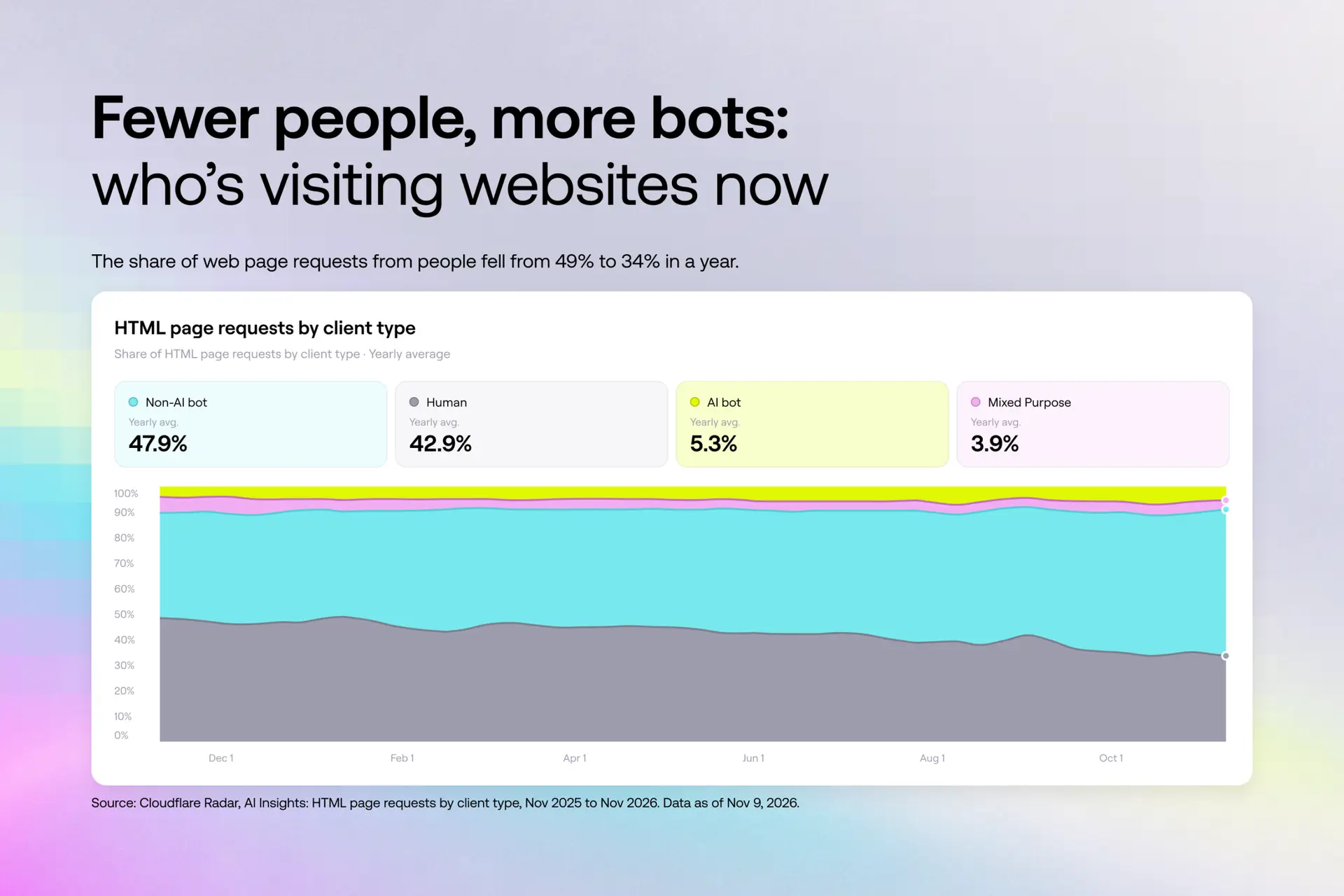
Fewer people, more bots: who’s visiting websites now
Finding a business online used to mean typing keywords into Google and scanning a page of links. Now, with AI search, more people describe what they need and let an AI assistant like ChatGPT, Claude or Gemini do the research for them.
Today, the next visitor to your site may not be human. In November 2025, 49% of requests for web pages came from people. By November 2026, it was 34%, according to Cloudflare Radar. That’s a drop of nearly a third in a single year. [source]
Ranking on Google is no longer enough. The assistant does the shortlisting: it might look at a dozen businesses and mention three. The rest are dropped before the person ever knows they existed.
Picture a bakery on Elm Street. Your agency built its website, and it looks great. A customer asks ChatGPT: “What’s the best bakery near Elm Street for event catering?” The assistant checks a handful of local sites and recommends three. The Elm Street bakery isn’t one of them. It does cater, but the catering page isn’t linked from the menu, so the assistant never found it. Neither you nor your client will ever know this conversation happened.
That’s not a mistake on your part. Being readable by AI assistants is a new requirement, and it’s fast becoming the standard for how websites are built. Without it, your clients miss visits and sales they never see. Sticklight’s Agent Ready scan helps close that gap before you publish. Here’s what agent ready means, why it matters now, and how to check every site you build.
What does agent ready mean?
More people now ask ChatGPT, Claude, Meta’s Muse, or Perplexity to find a business, compare options or book something, and the assistant visits the website for them. An agent-ready website or app is one those AI assistants can find, read and use.
These AI visitors are still a small slice of the web. In Cloudflare Radar’s data, AI bots make up about 5% of page requests, up from about 4% a year earlier. Most bots are still search crawlers and other automated tools, but the AI share is growing. [source]
You may also hear this called agentic search: an AI agent that researches, compares and acts on a person’s behalf. Agent readiness is how prepared your site or web app is for that visitor.
What the assistant does varies. Sometimes it answers a quick question. Sometimes it compares a few options. Sometimes it fills in a form or stages a booking, and the person just confirms. Each step asks more of your app.
If you already invest in SEO, you’re not starting over. Agent readiness builds on the same foundations: AI still needs to reach your pages, scan them, and understand what the business offers. It adds a layer made for the assistants visiting on a customer’s behalf.
None of this changes how your app looks to people. It’s the layer underneath that speaks to the assistants visiting on their behalf. Think of it as a good receptionist: every visitor, human or AI, gets pointed to the right place.
It’s a lot like “mobile-friendly” around 2015. Few people could explain responsive design, but everyone knew their site had to work on a phone.
Which projects should be agent ready?
Anything people should be able to find through an AI assistant: business websites, landing pages, portfolios, online stores, and the public pages of your web app, like pricing, booking or sign-up.
Private projects are different. Internal dashboards, client portals behind a login and admin tools usually should stay private, and the agent keeps signed-in and admin pages out of your AI guide and sitemap by default.
Why you need to be ready for AI agents
AI assistants are becoming the front door to your business. When they can’t get through it, three things go wrong.
If AI can’t find your website: missed traffic and lost leads
Remember the bakery. If an assistant can’t discover your pages, it can’t mention them. It sends the person to a competitor whose site is easier to find.
If AI can’t read it: a misrepresented business
A yoga studio’s homepage says “Find your flow” and little else. The browser tab still reads “Vite + React,” and there’s no Contact page. The assistant can’t tell it’s a yoga studio, or where it is, so it doesn’t suggest it.
When details are unclear, assistants can also get them wrong: old prices, the wrong opening hours. The owner never sees it happen.
If AI can’t act on it: friction that costs leads
Someone tells an AI browser: “Message the photographer about a wedding in June.” It opens the contact page, but the fields only have grey hint text and Send is a styled box. The assistant can’t tell what goes where, so it gives up. The visitor moves on to the next photographer.
AI assistants with browser access can already open a website and fill in simple forms, like a contact or quote request form, with the person confirming the last step. Clear labels and real buttons make that possible.
The three files that help AI find your website
Being found is the first step, and it starts with three small files behind your website. Visitors never see them. AI assistants and search bots read them first. The same files help AI find the public pages of a web app, like pricing or sign-up.
The most popular websites already have a sitemap and robots.txt, usually set up by SEO teams. The AI guide is newer, made specifically for AI assistants. If you’re running an older site or building an app today, all three are the standard to meet.
AI guide (llms.txt): a cheat sheet for AI
An AI guide is a short text file that tells assistants what your business is and where the key pages are, in a format they read quickly.
Without one, an assistant has to piece your business together from page designs and menus. With one, the bakery’s guide lists “Catering” as a key page, and the answer changes to “yes, they cater events.”
Sitemap: a map of every public page
A sitemap lists every public page in your website, with the date each one last changed.
AI search follows links, so a page nobody links to can go unseen. The sitemap makes sure nothing gets missed, and the dates tell AI which content is fresh.
robots.txt: the house rules for bots
robots.txt is a short file of rules that tells bots which pages they may read.
If it blocks AI search bots, even by accident, they skip your public pages entirely. A good robots.txt welcomes them to your public pages and keeps private ones out.
How to make sure your website is agent ready
Getting ready for AI assistants starts with two parts: make sure AI can find your website, then make your business easy to understand. The Agent Ready scan handles the technical part of step one before you publish.
Part 1: Make sure AI can find your site
Check and fix your website’s AI readiness before you publish, in one click, with the Agent Ready scan, powered by Ora AI. It looks for the three files above, so you can:
- Be findable by AI: your site has a map of its pages and welcomes AI search bots, so assistants like ChatGPT and Perplexity can discover it.
- Give AI a cheat sheet: an AI guide tells assistants what the business is and where the key pages are, in their own format.
- Launch with confidence: the scan sits in your pre-publish checks, next to SEO, Performance, Accessibility and Security. Every site you hand over starts with the foundations AI assistants look for, fixed in one click.
Here’s how to run it:
- Open your project in the Studio.
- In the top bar, click Production ready.
- Find Agent Ready and click Run scan. It takes about two minutes.
- Click View to open the report and see your issues and the checks that passed.
- Click Fix issues to send everything to the Sticklight agent, or Fix with AI on a single issue. The agent writes and updates the files for you.
- When the agent finishes, click Rescan to confirm the fixes.
If you change your site after a scan, the panel shows Changes made since this scan, so you’re never looking at stale results. Agent Ready is available on every plan, including Free. Scans and fixes run through chat, so they use your usual AI credits. See plans.
For the full walkthrough, see Agent Ready in the Help Center.
Some of the work is already done for you. Every site published on Sticklight is open to AI assistants, with nothing to set up: the hosting doesn’t stop them with an “are you a robot?” check.
The scan runs six checks across the three files. It checks that each file exists, is well formed, and that its links work:
- AI guide (llms.txt): exists, is well formatted, and its links work.
- Sitemap: exists, and shows when each page last changed.
- robots.txt: lets AI search bots read your public pages.
The agent keeps signed-in and admin pages out of your AI guide and sitemap by default.
It doesn’t check the quality of what’s inside, and it doesn’t promise AI will recommend your site. It also scans your preview before you publish, not your live site.
Part 2: Make your business easy to understand
Once AI can find your site, it needs to understand what you offer. That part is yours. Make the details an assistant looks for explicit, so it doesn’t have to guess:
- What you do and who it’s for, in plain words on the homepage
- Services, products and pricing
- Opening hours, location and contact details
- Policies, like cancellations or delivery
- Next steps, like how to book, order or ask for a quote
- The same details everywhere: assistants cross-check your site against your Google Business Profile, review sites and directories. If your hours or prices don’t match, they may quote the wrong one.
Then open your AI guide and read it like an assistant would. Does it describe the business the way the owner would? Does it point to the pages that matter?
Think of it like a tailor’s fitting. The scan checks that every seam is stitched. You decide whether the suit fits.
Why agencies should offer agent readiness now
Some agencies first heard about agent readiness from a client asking, “Is our site ready for ChatGPT?” You want to be the one who brings it up first.
Agent readiness is where SEO was years ago: most clients sense they need it, and few can explain it. Learn it now, and you’re the expert they call. Agencies already package AI search visibility the way they package SEO, and agent readiness fits the same models:
- One-time audit: check and fix an existing client site.
- Launch add-on: include agent readiness in every new build.
- Ongoing check: re-run the scan before each publish as part of a care plan or retainer.
The scan handles the technical setup, at no extra cost to your clients. Your expertise is the part they pay for: a guide that represents the business accurately, and the right pages made public.
Building for yourself? The case is simple. Every assistant that skips your site sends a lead somewhere else. Run the scan before you publish, fix what it finds, and read the AI guide so it sounds like you.
What’s next for agent readiness at Sticklight?
Today’s scan covers the first part: making sure AI can find your site. Here’s what’s on the roadmap:
- Be found: fuller checks of your page map, AI guide and robots rules
- Be understood: checks that your site says plainly what the business is and offers, with clear page titles, descriptions, and real About and Contact pages
- Be usable: checks that an AI browser can fill in your forms, press the right buttons, and follow links that lead somewhere real
- One readiness score, with plain-language results that explain what each gap means for your customers
- Fixes for every new check, with an agent that asks for details only you know, like your address or About text, instead of guessing
Get your next site ready for AI assistants
AI assistants are becoming the front door to your business, and to your clients’ businesses. Getting the basics right now means you’re ready before anyone asks.
Open your next project, run the Agent Ready scan before you publish, and see where you stand. Start building on Sticklight.
FAQs
What is agentic search?
Agentic search is when an AI assistant does the searching for a person. Instead of returning a list of links, it researches options, compares them against what the person asked for, and checks details like price or availability. It can also help with the next step. Often, the person never visits every site the assistant considered.
Does agentic search replace SEO?
No. Agentic search builds on the same foundations as SEO. AI assistants still need to discover your pages, read them, and understand what the business offers. Clear structure, accurate information and a solid technical setup still matter. Agent readiness adds a layer on top, made for the assistants visiting on a customer’s behalf.
How do I make my website or web app easier for AI agents to use?
Start by making sure AI can reach the pages that matter, with an AI guide, a sitemap and a robots.txt that welcomes AI search bots. Then make key details easy to find. For forms, ask the Sticklight agent: “Make every form accessible: visible labels, correct field types and autocomplete, and real submit buttons.”
Does the Agent Ready scan check my published website?
No. The scan runs on your site’s preview in the Studio, before you publish. It doesn’t watch or monitor your published site. Run it again before each publish, especially after big changes. The scan notices when your code has changed since the last run, so your results stay current.
Is the Agent Ready scan available on the Free plan?
Yes. The Agent Ready scan is available on every Sticklight plan, including Free. Scans and fixes run through chat, so they use your usual AI credits. You can compare plans and credit allowances on the Sticklight plans page.
If my scan passes, is my AI guide good enough?
Not necessarily. A passing scan means your AI guide (llms.txt), sitemap and robots.txt exist, are well formed, and have working links. It doesn’t judge the content. Read the guide yourself and check that it describes the business accurately, lists the pages that matter, and leaves out anything private.
Will an agent-ready website get recommended by ChatGPT?
No tool can guarantee that. Agent readiness helps AI assistants to find and read your site, which is the foundation for being recommended. What an assistant says also depends on your content, your reputation, and how well your site answers the person’s question. Readiness removes the barriers on your side.
Can an AI agent complete a sign-up or booking for my customer?
Not reliably yet. AI assistants with browser access can fill in simple forms, like a contact or quote request form. They stop at sign-up walls, and they fail on buttons that lead nowhere. Keep your main lead action, like a contact form, open and clearly labeled. Agent readiness is evolving fast, and we’ll keep adding checks to Agent Ready.
