
How a non-developer vibe coded a custom work order system in 2–3 weeks and skipped a $100K+ build

Yuval, American Door’s CTO, built NovaBlue in Sticklight to replace emails, phone calls and spreadsheets in the company’s work for a national shipping company. Today 30–40 people use it every day.
At a glance
- Customer: American Door, Long Island, NY
- Industry: Commercial door service
- Founded: Over 50 years ago
- Technical team: 2 people
- Built: NovaBlue, a work order management system for a network of partners who service a national shipping company’s facilities across the US
- Results:
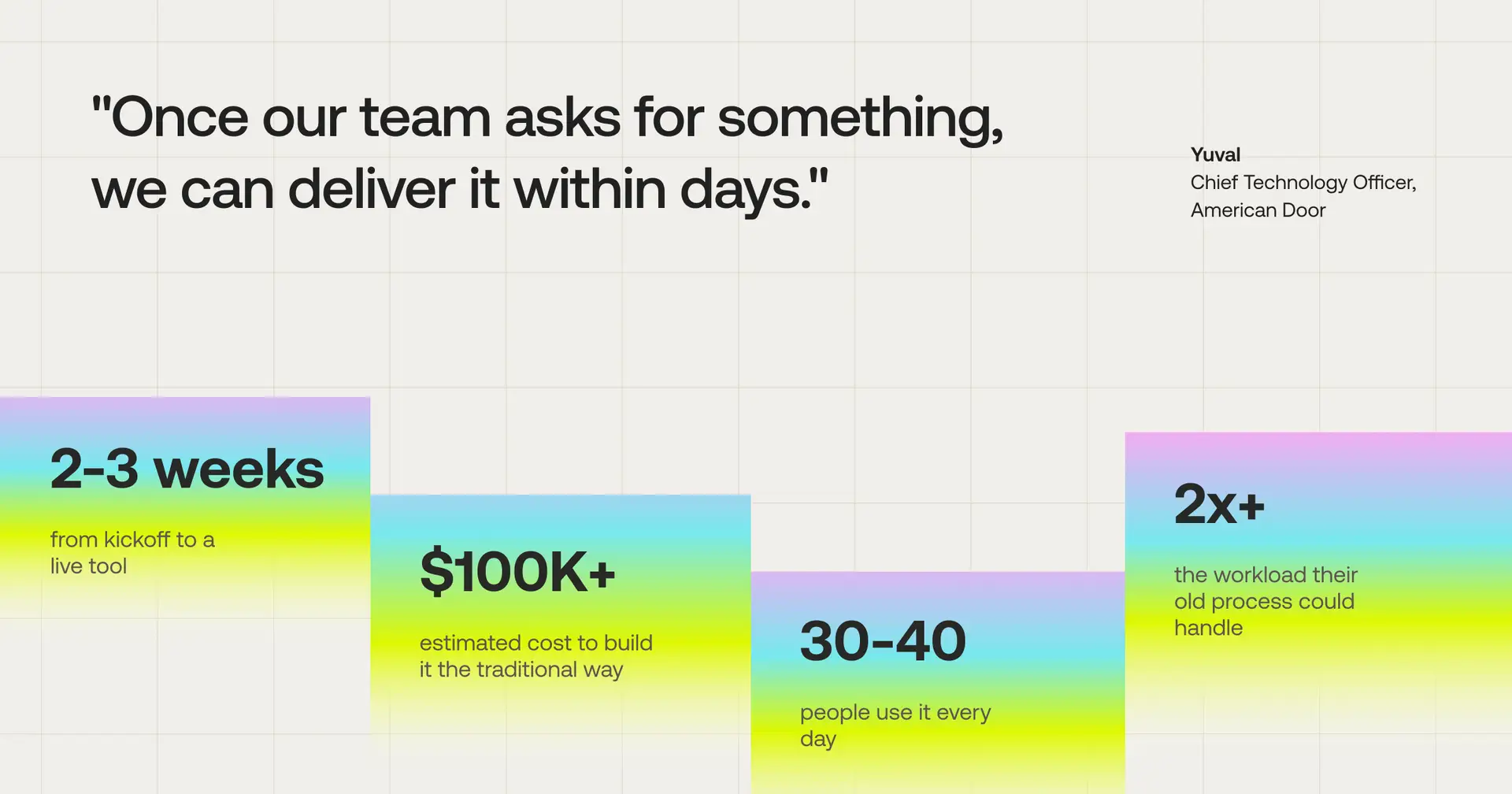
- 2–3 weeks from kickoff to daily use
- Yuval estimates an outside team would have needed at least three to four months and “over a hundred thousand dollars” to build what NovaBlue does today
- 30–40 daily users
- New feature requests delivered within days
The challenge: a new project with no ceiling on volume
American Door has served businesses across the New York region for more than 50 years, and some of the work still runs on paper. By Yuval’s own account, some aspects of the business stayed traditional when it comes to technology.
For years, the company looked for software to run the whole business. “We actually paid multiple companies for a year or even two before realizing it’s just not for us,” he says. None of it fit the way American Door works.
Then American Door took on a new project: servicing a national shipping company’s facilities across the US. The work comes through a facilities management company that handles maintenance for the shipping company.
The team knew from the start it would need a purpose-built tool. “We knew from the get go that we would have to use a tool that will allow us to manage whatever workload that will come at us,” Yuval says.
For a short time, the team got by with emails, phone calls and Excel sheets. “Very, very quickly everything started being a little bit too much.” Volume grew from day one. “The old way of doing things wouldn’t allow us to handle half the amount of work that we’re handling right now. It just wasn’t sustainable.”
The solution: one CTO, a five-person studio
American Door has two technical people. Yuval isn’t a developer: “I’ve been building websites and tools for many years, but I’m not a developer per se… from that point to actually coding a software is a very long distance.”
He picked Sticklight because he already knew Elementor, its sister company, and trusted the people behind both. He had never tried vibe coding. “I had zero knowledge of vibe coding before starting using Sticklight. I knew of it very well. I just thought this is not yet something that I should use for work tools.”
He got about a week’s notice before the project started. Two to three weeks later, the team was using the first version. Since then, he has kept improving it, adding features and connecting it to the facilities partner’s system.
What he built:
- Automatic intake: work orders arrive by email and come into the system through a webhook.
- One record per job: each work order holds the details, quotes, invoices generated on approval, before-and-after photos, and a full activity log.
- Map view: every work order by state and region, plus the regions each partner covers.
- Automated data flows: links to the facilities partner’s system so information flows back automatically.
- Client access: Facility managers log in to see the work orders, facility locations, assets and contacts in their region.
A job from start to finish
A work order reaches NovaBlue by email and lands in the system automatically. From there, Yuval explains, it “needs to contain all the information for the tech team to go into the field and check, test, fix, replace whatever is needed, and then they can relay the information back to us and complete the work order in time.”
Technicians upload before-and-after photos. Once a quote is approved, the system generates the invoice. Every step goes into an activity log, so the office can go back later and see what happened on any job.
No handoffs between idea and build
“Sticklight allows me to basically become a studio. If I have the brain power, if I have the time, I can essentially become a team of about five people and within days create things that before would have taken me months.”
Before, every new tool meant briefing other people. “I would have to communicate with a designer, with a developer, or maybe a few to get to something that I want to see, and that would take quite a long time.” Now he takes an idea straight to a working build. “Vibe coding just allows me to get to that point much, much faster.”
Building alone has a cost. He tests each release on the back end, then relies on users to report anything that needs changing, and he fixes problems as soon as he can.
Security: the part that kept him up at night
NovaBlue holds client logins, invoices, and facility contacts. Yuval knew a vibe-coded tool had to work and also had to be safe. “Security is a major factor and it’s the one thing that makes you sleep less good at night. I was worried about that from the beginning.”
When Sticklight released its security scan, he ran it right away. It checks the code and also how the code connects to the database, which is where data exposure often happens. The scan “raised my confidence in the tool a lot more.”
The finished product changed his view of vibe coding. “I was surprised at how good it was at building something that truly works and is secure.”
The results: more work, less manual handoff
30–40 people use NovaBlue every day.
Partners get work orders as they arrive. Nobody has to pass them along by hand. “We are saving a lot of time and we’re also able to do a lot more with less manpower overall.”
New features ship within days. Field teams aren’t used to working next to a developer, so Yuval asks them what they need. “Once they request anything, we can within days make sure they get what they’re asking for.”
Technicians use it because it fits their work. “In this industry you usually don’t see software that is made specifically for your needs.”
Building it another way would have cost far more. Yuval estimates an outside team would have needed at least three to four months and “over a hundred thousand dollars” to build what NovaBlue does today.
The portal its client wants other vendors to use
The facilities partner hadn’t seen its stats in a well-designed dashboard. NovaBlue gave it one. Each facility manager now sees all the work orders in their region on a map, along with each facility’s assets and contacts.
The partner liked it enough to want its other vendors on the system too. “They are happy to bring other vendors to work through our system,” Yuval says. For the partner, that means a chance to “be more efficient, reduce costs, and just have a bird’s eye view on the whole operation.”
The project also changed how American Door’s owners think about technology. It “allowed the owners and all stakeholders to understand how important it is… to invest more in technology.”
What’s next
NovaBlue covers one specific part of American Door’s operations for now. Next, Yuval plans to build software that runs operations across several companies under the same ownership.
Could another non-technical company replace its legacy system the same way? “Absolutely,” he says. “I highly recommend anyone to at least give it a go and not be afraid of what it can’t do, but rather just try to see what it can give you and take it from there.”