6 best AI prompts to build a website in 2026

The best AI prompts to build a website do more than name a topic. They tell the AI who the site is for, what pages it needs, what a visitor should do on it, and what tone it should carry. Get those four things into a single prompt and an AI website builder like Sticklight can turn it into a real, editable site in one pass, not a rough draft you have to fight with.
Below are six AI prompts to build a website, refined for different jobs: a small-business site, a portfolio, a landing page, a blog or CMS, a booking or lead-capture site, and a redesign of a site you already run. Each one comes with what it produces and a tip for making it sharper. Copy any of them into Sticklight’s prompt box, swap in your own details, and adjust from there. AI does the first pass. You keep control of every pixel after that.
- A strong AI prompt names the audience, the pages, the primary action, and the tone, not just the industry.
- Vague prompts produce vague sites. Specific, outcome-focused prompts produce sites you can publish with only light edits.
- Different site types need different prompt structures: a portfolio prompt should describe your work, a booking prompt should describe your calendar and confirmation flow.
- A redesign prompt should describe what to keep and what to change, since Sticklight builds on an existing WordPress or Elementor site rather than starting over.
- Skills, like SEO or Accessibility, can be added to any of these prompts in the Build phase, one click, no extra writing.
- Refining a prompt after the first build, rather than rewriting it from scratch, is usually the fastest way to get to a finished site.
Why specific AI prompts to build a website work better
An AI website builder works from the words you give it. A prompt like “build me a bakery website” leaves the AI guessing at your menu, your neighborhood, and your visual style, so it fills the gaps with generic defaults. A prompt that names the bakery’s specialty, location, hours, and the one thing you want visitors to do (order online, call, or walk in) gives the AI far less to guess at.
Outcome-focused prompts work the way a business brief works with a designer. You are not describing a website in the abstract, you are describing a result: a page that books appointments, a portfolio that gets a reply, a landing page that converts a specific offer. In Sticklight’s Prompt, Build, Publish flow, that first prompt sets the direction, and the Build phase is where you refine layout and copy by hand or with another prompt.
1. A prompt for a small-business website
Build a website for a family-owned Italian restaurant called Corner Trattoria. Include a home page with our story and hours, a menu page organized by course, a page for private event bookings, and a contact page with our address and a map. The tone should be warm and inviting, with earthy colors. The main goal is for visitors to call to make a reservation, so put the phone number in the header on every page.
This produces a multi-page site with clear navigation, a home page built around the restaurant’s story, and a menu laid out for easy scanning rather than a wall of text. Because the prompt states the goal, get a phone call, the AI treats the phone number as a persistent element instead of burying it in a footer.
Tip: if the tone leans too formal or too casual, tell Sticklight directly, for example “make the copy warmer,” and it will adjust without touching the layout you already like.
2. A prompt for a portfolio website
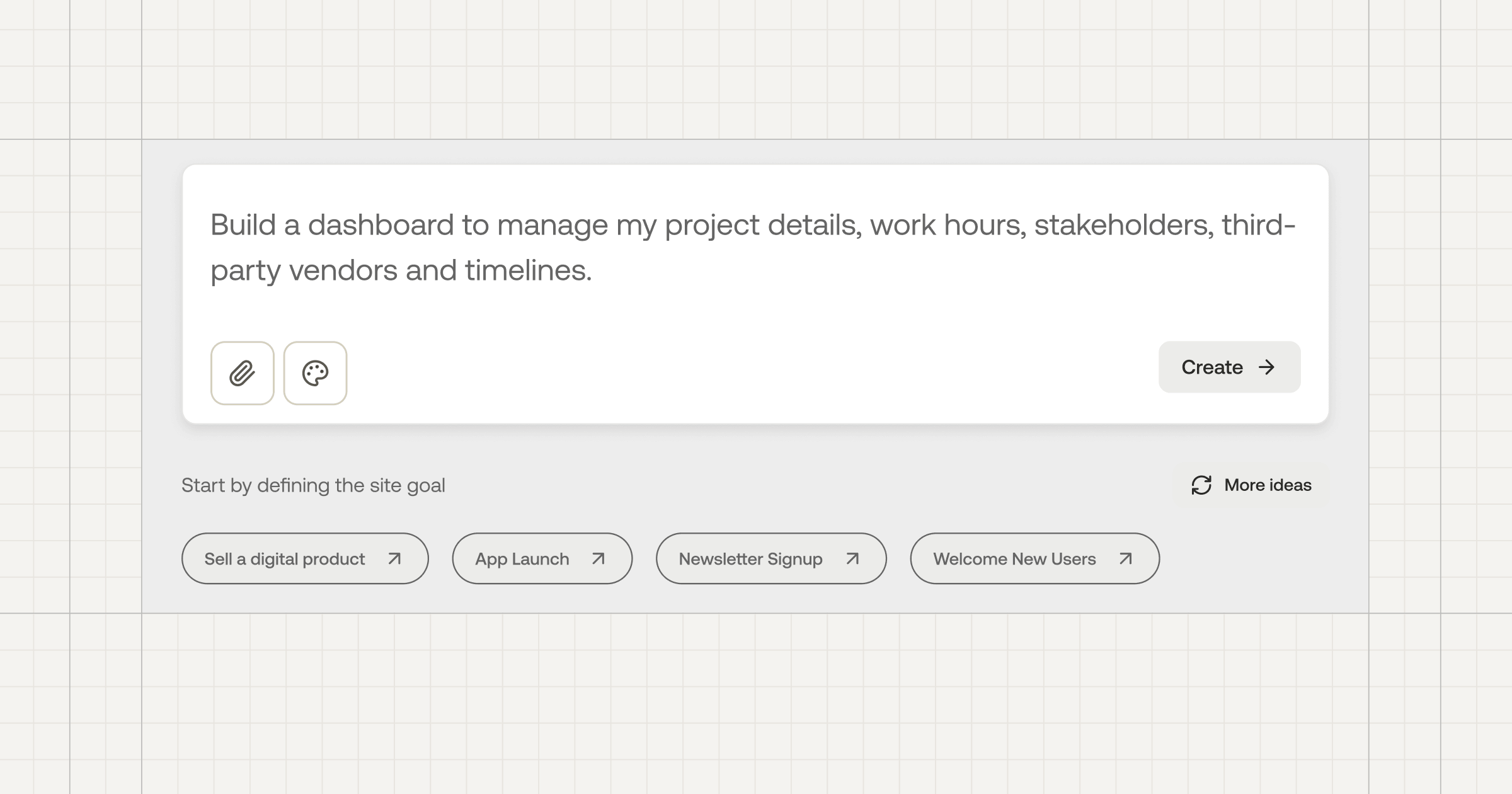
Build a portfolio website for a freelance product photographer. I shoot food, product, and lifestyle photography for small brands. Include a home page with a strong image grid, an about page with my background and process, a selected-work page organized by category, and a contact page with a simple inquiry form. Keep the design minimal so the photos are the focus.
This produces a visually led site where the grid and image sizing carry the design, rather than heavy text competing with the work. Naming the three categories gives the AI a structure to organize the portfolio around, instead of one long, undifferentiated gallery.
Tip: ask for the work page to be easy to update yourself, and once the site is built, add the Design System Skill so new pieces stay visually consistent as you add them.
3. A prompt for a landing page
Build a single landing page to promote a free 20-minute consultation for a financial planning service aimed at people nearing retirement. Include a headline that speaks to retirement confidence, three benefits of booking a consultation, a short section addressing common hesitations, and one clear call-to-action button that repeats twice on the page. No navigation menu, no distractions, just the offer.
This produces a focused, single-purpose page instead of a shrunk-down homepage. Because the prompt rules out a navigation menu and repeats the call to action, the AI treats conversion as the organizing principle, not an afterthought.
Tip: add the SEO Skill even for paid-traffic pages. It means the page is ready if you later want it to also earn organic traffic.
4. A prompt for a blog or CMS website
Build a blog for a small design studio. I want a home page that lists recent posts, a category system for case studies, tutorials, and studio news, an individual post template with room for images and pull quotes, and an easy way to add new posts without touching code. Keep the design clean and editorial, similar to a design publication.
This produces a working content structure: a listing page, categories, and a reusable post template, not a static homepage with no way to grow. Naming the categories up front means new posts have somewhere to live from day one instead of one undifferentiated feed.
Tip: mention how often you plan to publish. A weekly studio needs a template that stays clean at scale; a quarterly one can afford a more elaborate post layout.
5. A prompt for a booking or lead-capture site
Build a booking website for an independent massage therapist. Include a home page describing the services and pricing tiers, a booking page where clients can request an appointment time, a page of client intake questions collected before the first visit, and a confirmation message after someone books. Make the booking request the most prominent action on every page.
This produces a site organized around the booking flow itself: services, request, intake, confirmation, in that order, rather than a generic services page with a contact form bolted on. Stating that booking should be prominent everywhere keeps the AI from treating it as one option among several.
Tip: be specific about what happens after someone books, whether that’s an automatic confirmation, a follow-up call, or a payment step. The more precisely you describe the handoff, the less you rebuild later.
6. A prompt to redesign an existing website
I have an existing WordPress site for my law firm, and the design feels outdated and hard to navigate. Redesign it with a cleaner layout, a clearer path from the home page to booking a consultation, and a more modern look, but keep our existing practice-area pages, our logo, and our current content. Connect to our site and build on what’s already there rather than starting from a blank page.
This produces a refreshed structure and visual system while preserving the content and pages you already invested in. Because Sticklight connects to and extends an existing WordPress or Elementor site, a redesign prompt like this asks the AI to work with what exists, not replace it.
Tip: list what must stay, logo, disclaimers, specific page content, as clearly as what should change. A prompt that only describes the new look risks losing details you needed to keep.
A good afternoon spent tinkering teaches you more than a week of reading about how something is supposed to work.
Itamar Haim
Built by the Elementor team. Powered by Claude.
Let it glow.