Cursor vs Retool: an AI code editor against an internal app builder

Cursor and Retool both come up when you’re deciding how to build software faster, but they solve different problems. Cursor is an AI-assisted code editor built for developers writing and reviewing code. Retool is a platform for assembling internal business applications on top of your own data.
Here’s what each product actually does, how their pricing works, and where a full-stack vibe-coding platform like Sticklight fits alongside them.
- Cursor is an AI-assisted code editor (IDE) for software developers; it doesn’t host or deploy the applications its users build.
- Retool is a platform built for internal business applications, connecting to your own databases and APIs.
- Cursor’s paid tiers start at $20 per user per month for Individual Pro, after a $0 Hobby tier with a cap on agent requests.
- Retool’s Free tier is $0 per month, capped at 5 users and 500 workflow runs per month; paid builder seats start at $10 per month on annual billing.
- Sticklight is a vibe-coding platform, built by the Elementor team and powered by Claude, that turns a prompt into a production-ready, published site, app, dashboard, CMS, or internal tool.
What Cursor is built for.
Cursor is an AI-assisted code editor built for software developers, giving you in-editor coding agents, code review, and access to multiple frontier language models. Its feature set includes in-editor AI coding agents through Composer and Agent mode, cloud agents that run tasks remotely, Bugbot code review with usage-based billing, and support for MCP, skills, and hooks. Team plans add a shared marketplace and team context, and the Enterprise tier adds SCIM seat management and audit logs. Cursor is a code editor, not a hosted app-generation platform: it doesn’t host or deploy the applications you build inside it.
What Retool is built for.
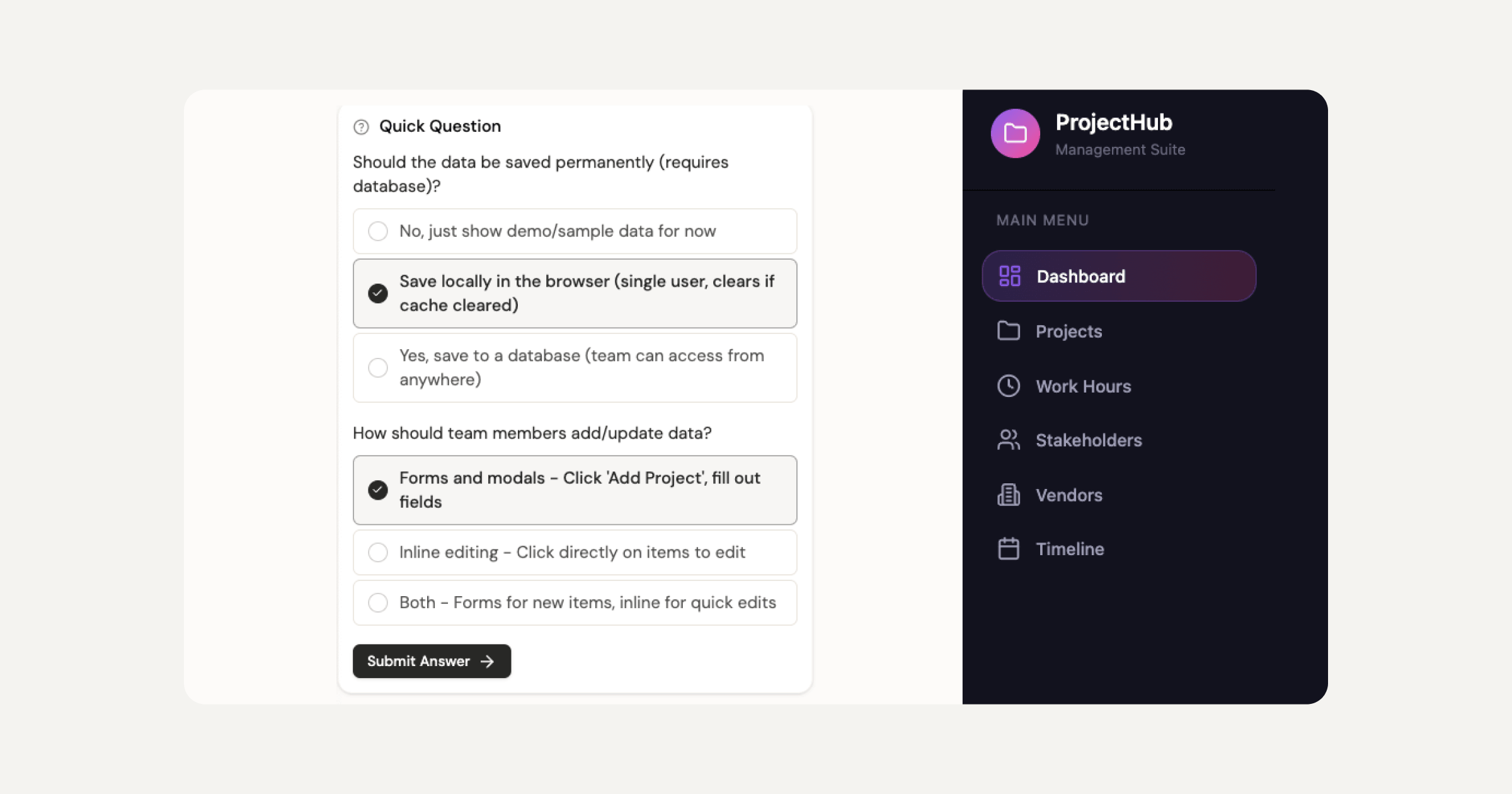
Retool is a platform for building internal business applications and automations that connect to your own data sources. It pairs a drag-and-drop UI builder with JavaScript and SQL for app logic, and includes workflow automation, scheduled or triggered runs kept separate from the app builder itself. Retool supports both cloud and self-hosted deployment, with pricing mirrored across the two. Its plans distinguish between “builder” seats, for people assembling apps, and “internal user” seats, for people who use the finished apps rather than build them, with external-user access on Business and above starting free for the first 50 users before moving to tiered per-user rates.
Cursor vs Retool at a glance
| Dimension | Cursor | Retool | Sticklight |
|---|---|---|---|
| What it is | AI-assisted code editor (IDE) for developers | Platform for building internal business apps and automations | Vibe-coding platform that turns a prompt into a production-ready website, app, dashboard, CMS, or tool |
| Output | Code, written and reviewed inside the editor with AI agents | Internal business applications built on top of your own data | Production-ready, published full-stack output from a single prompt |
| Backend / data | None built in; you connect and write your own backend | Connects to your own databases and APIs (customer-hosted data) | Generated as part of the full-stack build, from prompt through production-ready output |
| Publish / hosting | Not applicable; Cursor doesn’t host or deploy the apps it helps build | Cloud or self-hosted deployment options | Publish is included, as part of the prompt, build, publish flow |
| Best for | Developers who want AI-assisted coding inside a familiar editor | Teams building internal tools on top of existing company data | Professional web creators who want a full-stack site, app, dashboard, or tool without assembling it piece by piece |
| Entry pricing | $0/month Hobby tier (capped agent requests); paid plans from $20/user/month | $0/month Free tier (capped at 5 users, 500 workflow runs/month); paid builder seats from $10/month, billed annually | Additive to your WordPress/Elementor stack |
How the pricing tiers compare.
Cursor’s paid ladder runs from Individual Pro at $20 per user per month, up through Teams Standard at $40 per user per month, with Pro+, Ultra, and Teams Premium sitting above those two published figures. Enterprise is custom, priced through sales. Retool’s ladder splits by seat type: Team plan builder seats run $10 per month billed annually or $12 per month billed monthly, while internal user seats run $5 or $7 per month on the same billing split. Business plan builder seats run $50 or $65 per month, with internal user seats at $15 or $18 per month. Retool Enterprise, like Cursor Enterprise, is quote-based. Sticklight pricing isn’t published in dollar figures here; it sits additively alongside your existing WordPress and Elementor stack rather than as a standalone line item to compare seat-for-seat.
Where these tools differ in practice.
The practical split comes down to who’s doing the building and what they end up with. Cursor keeps you in an editor, writing and reviewing code with AI assistance, and leaves hosting and deployment to whatever infrastructure you already use. Retool keeps a builder inside its own environment, wiring existing company databases and APIs into internal-facing screens, with a licensing model that charges differently for the people building versus the people using the result. Neither tool is aimed at producing a public-facing, production-ready site or app from a single prompt; that’s a different job than either was built for.
Where Sticklight fits.
Sticklight is a vibe-coding platform for professional web creators: it turns a prompt into production-ready websites, apps, dashboards, CMS instances, and internal tools, following a prompt, build, publish flow, with publishing built into that flow rather than treated as a separate step. It’s built by the Elementor team and powered by Claude, and it’s additive to WordPress and Elementor, working alongside that ecosystem rather than replacing it. If you’re comparing Cursor and Retool, the relevant distinction is scope: Cursor has you writing and hosting code independently, and Retool is scoped to internal applications tied to existing company data. Sticklight is built for producing and publishing full-stack output, sites, apps, dashboards, CMS, and tools, from one prompt. AI agents are on Sticklight’s roadmap as a coming feature, not a shipped capability today.
What I filter incoming work by has changed from is this a website to is this something worth building.
Itamar Haim
Frequently asked questions
Is Cursor vs Retool a fair head-to-head comparison?
Not entirely. Cursor is a code editor for developers, and Retool is a platform for internal business applications. Both can speed up building software, but they’re built for different jobs, so the real question is which job matches what you need to build.
Does Cursor host or deploy the applications it helps build?
No. Cursor is a code editor, not a hosted app-generation platform. It gives you in-editor AI coding agents and code review, but you’re responsible for hosting and deploying whatever you build.
What does Retool cost to get started?
Retool has a Free tier at $0 per month, capped at 5 users and 500 workflow runs per month. Paid Team plan builder seats start at $10 per month on annual billing, or $12 per month billed monthly, with separate, lower rates for internal user seats.
How is Sticklight different from Cursor and Retool?
Sticklight generates and publishes a full-stack site, app, dashboard, CMS, or internal tool from a single prompt, rather than functioning as a code editor or an internal-app builder tied to existing company data. It’s built by the Elementor team, powered by Claude, and designed to work additively alongside WordPress and Elementor.
Can Sticklight replace my existing WordPress or Elementor site?
No. Sticklight is additive to WordPress and Elementor, working alongside them rather than replacing them.
Built by the Elementor team. Powered by Claude.
Let it glow.