How much does it cost to make an app?

The honest answer is that the cost to make an app depends almost entirely on how you build it, not on some fixed price tag attached to “an app” as a category. A simple internal tool a small team builds and maintains itself sits in a completely different bracket than a client-facing product built by an agency, with custom integrations and years of support ahead of it. What matters more than any single figure is the build model you choose, because the model decides most of the cost before a single feature gets built.
For founders and agencies pricing client work, the real question isn’t “what’s the number,” it’s “which build model fits this app, and what will it cost in time, team, and upkeep.” This guide compares agency and developer builds, no-code platforms, and AI app builders, and looks at how a platform like Sticklight changes the trade-offs.
- Cost is driven by scope, integrations, and ongoing maintenance, not by the fact that something is technically “an app.”
- Traditional agency or developer builds trade higher upfront cost and longer timelines for full custom engineering and dedicated support.
- No-code platforms often lower the initial build cost but shift spend into recurring, usage-based pricing as the app grows.
- AI app builders compress the build phase itself. How much time and cost that saves depends on how much manual integration work still remains.
- Maintenance and iteration, not the first build, are usually the largest cost over an app’s lifetime.
- Sticklight builds from a plain-language prompt and then hands you full control to edit every pixel, on plans that scale with seats and features rather than usage volume.
What determines the cost to make an app
Two apps that sound similar on paper, “a booking tool,” “a client dashboard,” can land at very different cost levels once you account for what each one actually needs to do. Four factors drive most of the difference.
- Scope. A single-screen internal tool with one data source costs less to build and run than a multi-role platform with permissions, workflows, and reporting.
- Integrations. Connecting to a payment processor, CRM, calendar system, or third-party API adds engineering time and ongoing dependency management, regardless of build model.
- Maintenance. Every app needs updates, bug fixes, and security attention after launch, often the cost founders and agencies underestimate most.
- Team size and expertise. A solo founder self-editing a build has a very different cost profile than an agency staffing a designer, a developer, and a project manager.
Most budgets blow up not because the first version was priced wrong, but because scope grows mid-build: one more integration, one more user role, one more edge case. Locking a clear first-version scope before you start is the single biggest lever you have over cost.
Traditional agency and developer builds
Hiring an agency or a freelance development team is the model built for full custom engineering: discovery, design, custom code, quality assurance, and a dedicated point of contact who can staff up for complex integrations or compliance requirements. It tends to make sense when the app is deeply custom, has real regulatory constraints, or needs engineering beyond what any packaged tool covers.
The trade-off is a timeline and cost that scale with the hours a team puts in, plus an ongoing retainer or project-based relationship to keep the app maintained after launch.
No-code platforms
Visual, drag-and-drop platforms let founders and smaller teams assemble an app without writing code. A well-known example is a mature visual app builder with a plugin ecosystem for extending functionality.
No-code platforms usually lower the cost of getting a first version live, but the trade-off shows up later, in pricing that often scales with usage: records stored, workflow runs, active users, or plugin dependencies. That often pays off for straightforward internal tools or early-stage MVPs. For apps expected to scale to a large user base, it’s worth mapping the recurring cost a year or two out.
AI app builders and the prompt-to-app model
A newer category of tools turns a plain-language prompt into working software, compressing a build phase that used to take weeks into something far shorter. Coverage varies across the category: some tools suit rapid prompt-to-app marketing sites, others generate front-end components inside popular app frameworks, some pair a cloud IDE with an AI agent, others lean on agent-driven app generation, and some serve engineers working directly inside a code editor.
Across this category, the cost conversation shifts from hours billed by a team to a plan tier based on the features and capacity needed. How much an AI app builder actually saves still depends on how much custom integration, design refinement, or hand-editing the final product still needs.

How Sticklight changes the cost equation
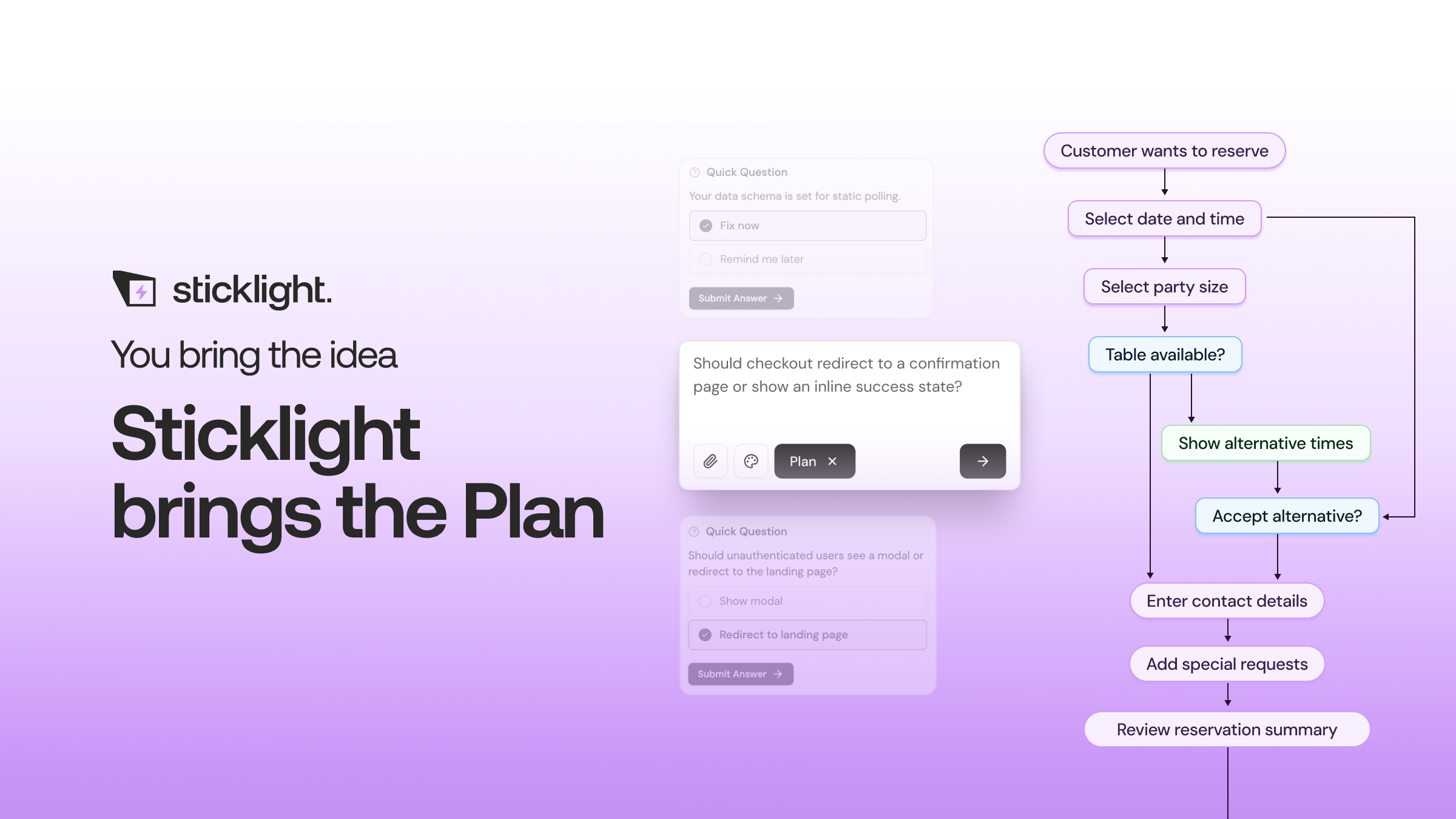
We built Sticklight as the vibe-coding platform for professional web creators, made by the Elementor team and powered by Claude. It turns a professional web creator into a full-stack creator, going beyond websites to build production-ready apps, dashboards, CMS, and internal tools, to the standard of a senior designer and developer rather than a rough demo.
The cost story has two parts. AI does the heavy lifting from your first prompt, which compresses the time a first version typically requires. Then, and this is the part professional creators care about most, Sticklight hands you full control: you can edit every pixel and adjust logic directly on the canvas instead of re-briefing a team for every small change.
Skills add packaged expertise to any project with one click, accessibility, SEO, performance, design system consistency, copywriting, localization, micro-interactions, onboarding, and 3D web experiences among them, so a founder or small agency team doesn’t need to hire a specialist for every discipline. Agents, a roadmap feature for automating more of the workflow, are coming soon and not yet part of the live product.
Plans scale with seats and feature access, not page count or usage volume: Free to try the platform, Pro for independent creators and small studios, Team for multi-seat collaboration with more Skills and capacity, and Enterprise with SSO, security review, and dedicated support. A bring-your-own-keys option is available on select plans for teams that want direct control over their AI costs.
The real cost after launch: maintenance and iteration
Whichever model you pick, the first build is rarely the biggest cost over an app’s life. Bug fixes, feature requests, API changes, and security updates keep arriving long after launch day. Agencies typically price this as an ongoing retainer, no-code platforms fold it into a subscription tier as usage grows, and AI app builders vary. The ones that hand you real editing control tend to make iteration cheaper, since you’re not waiting on someone else’s schedule for every small fix. That’s the part of Sticklight’s model that matters most for cost: editing a build directly, instead of re-prompting from scratch, keeps iteration close to a self-serve cost.
Choosing the right model for your project
Founders building their own product tend to value speed to a working first version, the ability to self-edit without a developer on call, and a plan structure that’s predictable as the product grows. Agencies delivering client work weigh different priorities: how fast they can get a professional-grade first draft in front of a client, whether the output meets a standard that protects the agency’s reputation, and whether the deliverable is real code they can hand off or keep extending.
The cheapest app is rarely the one with the lowest sticker price on day one. It’s the one whose ongoing cost matches how the product actually gets used and changed after launch.
None of this requires walking away from an existing WordPress or Elementor site. Sticklight is built to connect to and extend the sites and workflows a team already has, rather than asking anyone to start over.
A prototype earns forgiveness that a live product never gets, so it pays to treat every shortcut you take as a debt that collects interest.
Itamar Haim
Built by the Elementor team. Powered by Claude.
Let it glow.