How to Build a SaaS MVP in 2026

To build a SaaS MVP, you pick one real problem, build the single feature that solves it, and put it in front of real users within weeks, not months. Skip the extras. Skip the polish. A minimum viable product only needs to prove that people will use, and ideally pay for, the core thing you’re offering.
Founders who ask how to build a SaaS MVP usually already have too many ideas and not enough clarity on what to cut. This article walks through defining the problem, scoping the smallest useful version, choosing a build approach that fits your timeline and budget, and launching in a way that actually generates feedback instead of silence.
What a SaaS MVP is and why it matters
A SaaS MVP is the smallest version of your product that delivers real value and lets you test a genuine hypothesis about what users want. It’s not a demo, not a prototype you show only to friends, and not a stripped-down version of your full vision. It’s a working product someone can sign up for and use.
The point of an MVP is speed of learning. Every week spent building features nobody asked for is a week you didn’t spend finding out whether your core idea holds up. Treat the MVP as a question you’re asking the market, and treat launch as the moment you start getting an answer.
Define the core problem and one core feature
Before writing a line of code, write one sentence describing the problem you’re solving and for whom. If you can’t state it that simply, you’re not ready to build. Vague problems lead to bloated products that try to please everyone and end up useful to no one.
Once the problem is clear, pick the single feature that solves it best. Not three features. One. Everything else, onboarding flourishes, settings pages, integrations, gets cut from version one. Users forgive a narrow product. They rarely forgive a confusing one that tries to do too much at once.
Scope the smallest useful version
Your MVP needs just enough around the core feature to function as a real product: a way to sign up, the feature itself, and payment if you’re charging from day one. Nothing else earns a place in this version, no matter how small it feels to add.
- Sign-up and login, kept as simple as email and password or a single social login
- The one core feature, built well rather than several features built roughly
- Payments, only if you need revenue signal immediately rather than after initial feedback
- Basic account settings, limited to what users need to keep using the product
Anything not on that list, admin dashboards, analytics, multi-user permissions, waits until you know the product is worth building further.
Choose your build approach
No-code and low-code tools work well when your core feature is mostly forms, workflows, or content, and you want to validate demand before writing custom software. They’re fast and cheap, but they hit walls quickly once your logic gets specific or your data model gets complex.
AI-assisted build tools now sit between no-code and custom development, letting you describe what you want and get working software back, often with real code underneath instead of a locked-in builder. Custom development still makes sense for complex, technical, or highly differentiated products where the core feature is the whole business.
Build, launch, and validate with real users
Launch as soon as the smallest useful version works, even if it feels early. A product ten people are actually using teaches you more in a week than a product one hundred people might theoretically like. Waiting for it to feel ready almost always means waiting too long.
Recruit your first users directly rather than hoping they find you. Reach out to people who have the problem you’re solving, watch how they actually use the product, and pay closer attention to what they do than what they say. Behavior tells you more than opinions do.
Iterate based on what you learn
Early usage data will surprise you. Features you assumed were essential go untouched, while a small detail you barely thought about becomes the reason people stick around. Let that evidence guide your roadmap instead of your original plan or your personal preferences.
Keep iteration cycles short. Ship a change, watch how it affects real usage, then decide what’s next. A SaaS MVP isn’t a single release, it’s the start of a loop that keeps tightening the fit between your product and the problem it was built to solve.
Where Sticklight fits
Once you know what your MVP needs to do, Sticklight turns that plan into a production-ready website, app, dashboard, CMS, or tool directly from a prompt. Instead of assembling a stack, hiring help, or learning a new framework, you describe the core feature and get working software you can put in front of real users fast, letting you become a full-stack creator without the usual overhead.
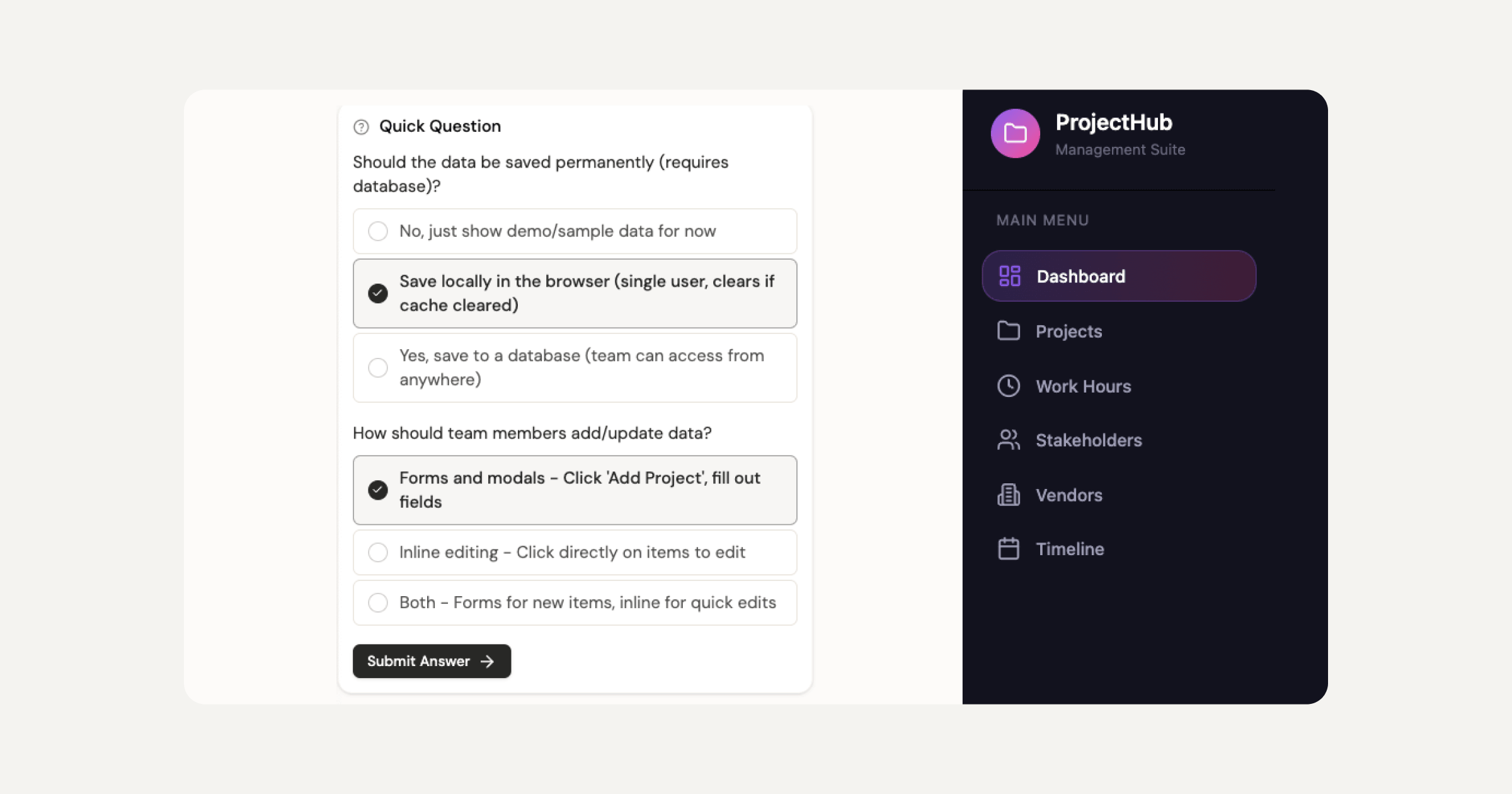
Sticklight also fits alongside what you already have. If your marketing site runs on WordPress or Elementor, keep it there and let Sticklight handle the application layer, the sign-up flow, or the core feature itself, so you’re adding capability rather than rebuilding what already works.
Frequently asked questions
What is a SaaS MVP?
A SaaS MVP is the smallest version of your software product that delivers real value to early users, built to test your idea and learn quickly before investing in the full product.
How long does it take to build a SaaS MVP?
With modern tools, a focused MVP can be built in weeks rather than months. The timeline depends on the features, integrations, and how tightly you scope the first version.
What features should a SaaS MVP include?
Only the core feature that solves the main problem, plus the basics to use it, such as sign-up, a simple dashboard, and payments if you charge from day one.
Do I need to code to build a SaaS MVP?
Not necessarily. No-code, low-code, and AI build tools can create much of an MVP, though custom logic or integrations may still need developer help.
How do I validate a SaaS MVP?
Put it in front of real users, watch how they use it, and track whether they sign up, pay, and come back. Real behavior tells you more than opinions.
Built by the Elementor team. Powered by Claude.
Let it glow.