Vibecode alternatives: 6 AI app builders compared

You start looking at Vibecode alternatives once you need more than a mobile-focused, prompt-to-app generator. Vibecode is an AI natural-language app generation platform built on Claude, and it’s used to create mobile apps, websites, and related digital projects for non-technical creators. Its pricing page renders plan details in the browser, so exact dollar figures aren’t published in a quotable form.
Here are six tools, from full-stack prompt-to-app platforms to dedicated mobile app builders, to show where each one is strongest.
- Vibecode is a Claude-powered, prompt-to-app generator focused on mobile apps and websites. It’s billed on a credit system described as pass-through AI cost, and its exact plan prices aren’t published.
- Sticklight, built by the Elementor team and also powered by Claude, turns a prompt into production-ready websites, apps, dashboards, CMS, and internal tools, then publishes them. It works alongside your existing WordPress or Elementor setup rather than replacing it.
- Bilt, Rork, and RapidNative generate mobile app codebases, mainly React Native and Expo, from prompts, chat, or sketches, and ship apps to the App Store and Google Play.
- FlutterFlow and Adalo take a more visual, drag-and-drop approach to mobile app building. FlutterFlow generates a Flutter codebase, and Adalo publishes through its own hosted apps.
- Entry-level paid plans among these tools range from about €15 a month to $39 a month, and every listed tool offers a free tier.
- Where a vendor’s pricing page couldn’t be confirmed, this article says so rather than estimating a figure.
Who looks for Vibecode alternatives
You look into Vibecode alternatives for a few concrete reasons. You need output beyond a mobile app, like a full website or an internal dashboard alongside it. You want a tool that integrates with your existing WordPress or Elementor site rather than standing apart from it. Or you want to compare Vibecode’s mobile-first, credit-based model against tools with published pricing. The six tools below span full-stack generation, dedicated mobile builders, and visual no-code editors, so the right fit depends on what you’re building.
Sticklight: a full-stack alternative built by the Elementor team
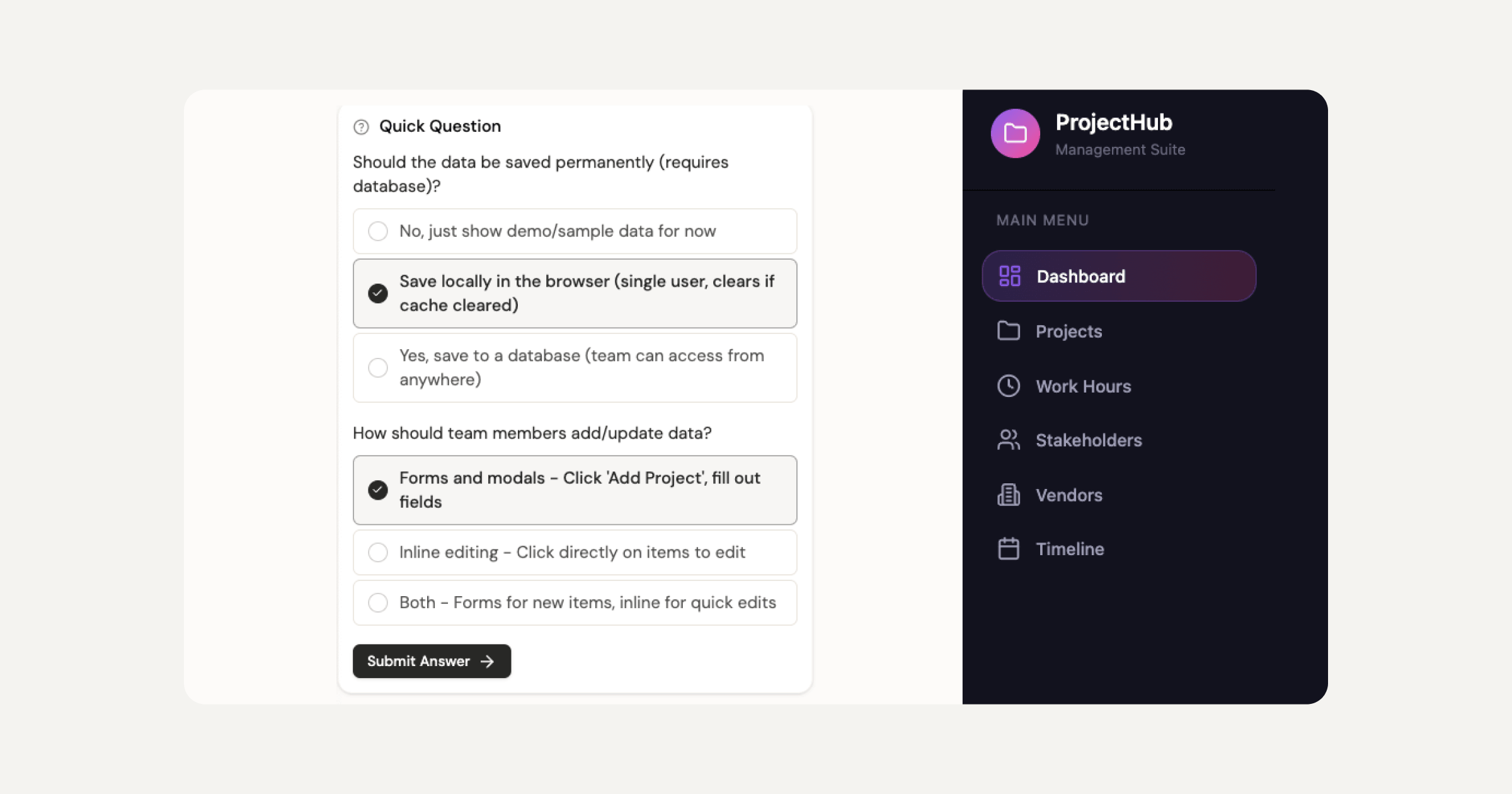
Sticklight is the vibe-coding platform for professional web creators. You turn a prompt into production-ready output, including websites, apps, dashboards, CMS setups, and internal tools, through a Prompt, Build, Publish flow that generates real output and publishes it. Sticklight is built by the Elementor team and powered by Claude, and it’s additive to WordPress and Elementor: it works alongside them rather than treating either as something to replace. AI agents are on Sticklight’s roadmap as a coming-soon capability. If you’re a professional creator who wants one prompt to produce a full-stack result and publish it, rather than a mobile app specifically, Sticklight is the logical starting point on this list.
Bilt: mobile app generation from natural-language prompts
Bilt is an AI prompt-based platform that generates a React Native and Expo mobile app codebase from natural-language descriptions. It’s aimed at non-technical founders building and publishing a mobile app. It streams a live app preview to your phone without requiring Xcode or a Mac, supports one-click publishing to the Apple App Store and Google Play, and allows export to GitHub. Bilt’s free plan is €0 per month, and its Professional plan runs €15 per month introductory, €25 per month standard, with figures denominated in euros on Bilt’s own pricing page. An Enterprise tier is available at custom pricing.
Rork: a chat-driven app builder
Rork is a conversational, AI-chat-driven platform for generating and publishing mobile and web apps, marketed to non-technical users and app founders. It ships apps to the App Store and offers a mobile app for building directly on your phone. Rork’s free plan is $0 per month. Rork Pro runs from $20 per month for 100 credits up to $100 per month for 500 credits, and Rork Max runs from $200 per month for 1,000 credits up to $1,800 per month for 10,000 credits, with custom pricing above that usage level.
RapidNative: prompts, sketches, and screenshots into React Native code
RapidNative is an AI platform that converts prompts, sketches, documents, or screenshots into React Native application code. It’s targeted at founders, product managers, designers, developers, freelancers, and agencies, and it exports source code or publishes directly to app stores. RapidNative’s free tier is $0 per month for 20 credits, with paid tiers starting at Starter for $20 per month (50 credits) and rising through Pro, Max, and Ultra tiers up to $199 per month (725 credits), plus a custom Enterprise tier.
FlutterFlow: visual building on a Flutter codebase
FlutterFlow is a visual, drag-and-drop app development platform for building Flutter-based mobile and web applications, used by individual developers and teams. It includes more than 200 pre-built widgets, generates a Flutter codebase that compiles to iOS, Android, and web, and connects to Firebase or Supabase as backend options, with code export available on paid plans. FlutterFlow’s free plan is $0 per month, and its Basic plan is $39 per month. The Growth plan is $80 per month for the first seat and $55 for each additional seat, and the Business plan is $150 per month for the first seat and $85 per seat for seats two through five.
Adalo: no-code, native app store publishing
Adalo is a no-code platform for building native mobile and web applications, including publishing to the Apple App Store and Google Play Store. It provides a drag-and-drop visual editor and a built-in database, with a 500-record limit on its free plan, and it uses flat, plan-based pricing rather than usage-based charges. Adalo’s free plan is $0 per month, its Starter plan is $36 per month billed annually, its Professional plan is $52 per month billed annually, and its Team plan is $160 per month billed annually, plus a separate custom-priced Adalo Blue tier for enterprise needs.
Vibecode alternatives at a glance
| Tool | What it is | Entry pricing | Best for |
|---|---|---|---|
| Sticklight | Prompt-to-full-stack platform for websites, apps, dashboards, CMS, and internal tools | Additive to your WordPress/Elementor stack | Professional creators wanting production-ready, full-stack output and publishing |
| Bilt | Prompt-to-React Native/Expo mobile app generator | Free; Professional from €15/month introductory | Non-technical founders shipping a single mobile app |
| Rork | Chat-driven mobile and web app generator | Free; Rork Pro from $20/month | Founders who prefer a conversational build flow |
| RapidNative | Prompt/sketch-to-React Native code generator | Free; Starter from $20/month | Teams that want exportable React Native source code |
| FlutterFlow | Visual drag-and-drop Flutter app builder | Free; Basic $39/month | Developers who want a visual editor over a Flutter codebase |
| Adalo | No-code native mobile and web app builder | Free; Starter $36/month billed annually | Teams wanting flat, plan-based pricing and app store publishing |
How these tools differ in output and backend
The main split among these tools comes down to what they actually produce. Bilt, Rork, and RapidNative aim squarely at mobile apps, generating or exporting React Native and Expo code and pushing straight to app store publishing. FlutterFlow follows a similar mobile-first path through a visual canvas over a Flutter codebase, with Firebase or Supabase available as a backend. Adalo is closer to a traditional no-code builder, with its own hosted database and both native app store and web output. Sticklight sits apart from all five by not being mobile-specific. Its output spans websites, apps, dashboards, CMS, and internal tools from a single prompt, and it’s designed to sit alongside your existing WordPress or Elementor site rather than replace a mobile-app tool.
Vibecode’s own positioning is a prompt-to-app generator powered by Claude, covering mobile apps, websites, and content-management-style tools, with monthly and annual billing. Its credit-based billing is described by the vendor as pass-through AI usage cost. Because Vibecode’s pricing page didn’t publish confirmed dollar figures at the time of research, check their site for current pricing before comparing costs against the tools above.
Frequently asked questions
What are the best Vibecode alternatives for building a mobile app?
Bilt, Rork, and RapidNative are your closest mobile-focused matches, since each generates a React Native or Expo codebase from a prompt and supports app store publishing. FlutterFlow and Adalo are also mobile-capable, but they lean more visual and no-code than prompt-driven.
Is Sticklight a good alternative to Vibecode?
Yes, if you’re a professional creator who wants a single prompt to produce a full website, app, dashboard, or internal tool and publish it, especially alongside your existing WordPress or Elementor site. It isn’t mobile-app-specific the way Vibecode, Bilt, Rork, and RapidNative are.
Does Vibecode publish clear pricing compared to these alternatives?
No, not at the time of research. Vibecode’s pricing page renders its plan cards in the browser and didn’t return confirmed dollar figures, while Bilt, Rork, RapidNative, FlutterFlow, and Adalo all have verified figures on their official pricing pages.
Which of these tools export code I can keep?
RapidNative and FlutterFlow both offer code export on paid plans, and Bilt supports export to GitHub. Adalo’s published plans don’t mention code export; its apps run on Adalo’s own hosting.
Built by the Elementor team. Powered by Claude.
Let it glow.