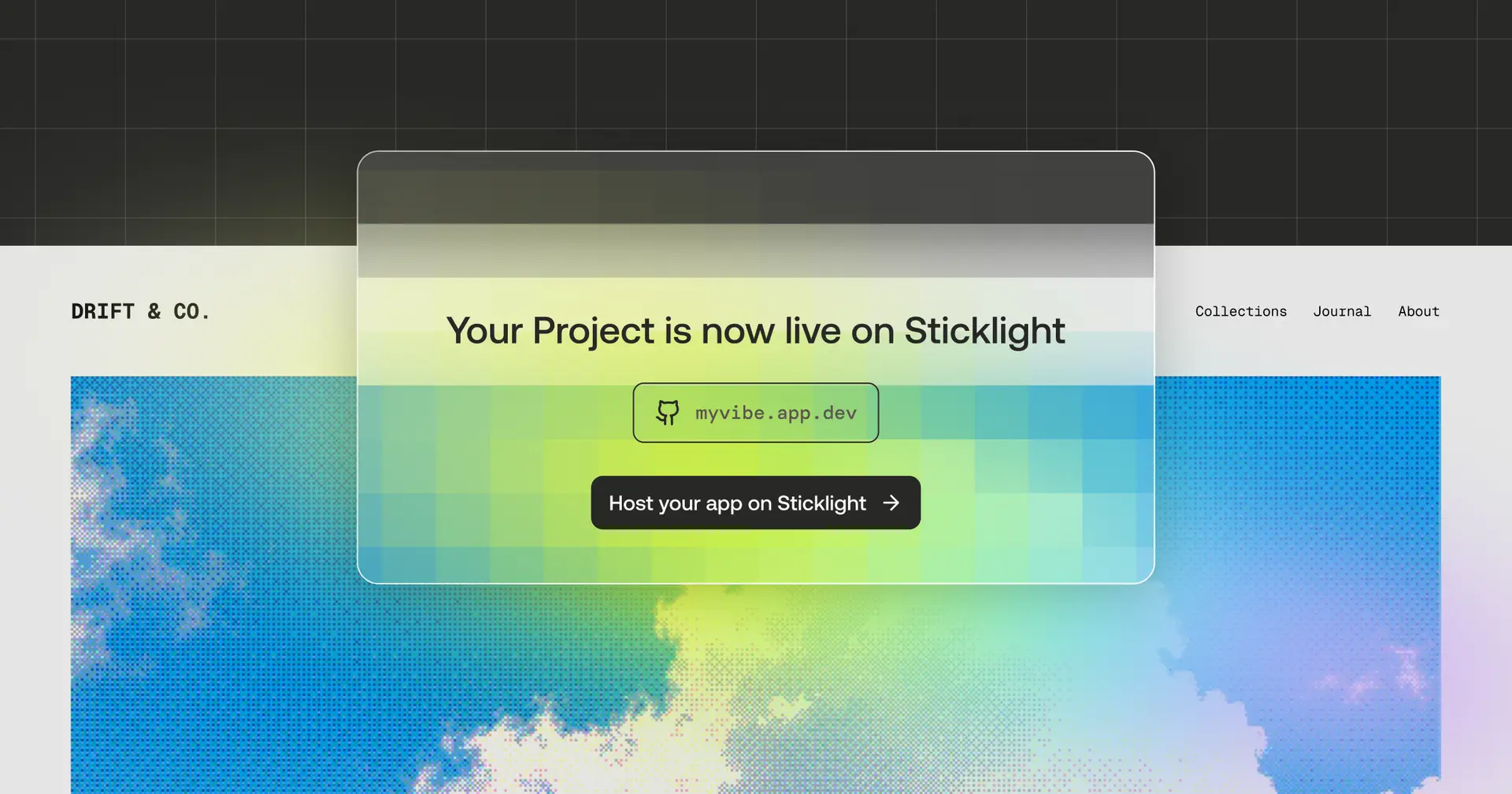
Host a Cursor or Claude Code app in minutes with Sticklight Cloud

You built a React app in Cursor over the weekend. It runs on localhost, the code is on GitHub, and the next step is the one nobody enjoys: picking a host, wiring up a build and working out why the output folder is wrong.
That’s the step Sticklight Cloud takes off your plate. You can now host a Cursor or Claude Code app on Sticklight straight from your GitHub repo. Connect the repo, confirm the build settings Sticklight detects, and your site is live on a sticklight.app address in about a minute.
If you missed the launch, Introducing Sticklight Hosting covers why we built it. This guide below is the hands-on part: how it works, what it supports today and where it fits next to the rest of Sticklight.
[Tutorial video placeholder]
Why host your AI-built app on Sticklight Cloud
Think of GitHub as the handoff in a relay. You write the code wherever you like and push it, and Sticklight Cloud takes the baton from there. Your editor, your repo and your habits stay the same.
Host what you already built
Connect GitHub, then give Sticklight access to all your repositories or only the ones you choose. Public and private repos connect the same way. Nothing gets migrated or rebuilt, because Sticklight deploys your code exactly as it sits in the repo.
Build settings, detected for you
Build config is usually the fiddly part. Sticklight reads your repo and fills in the framework, install command, build command and output folder. If something looks off, you can edit it before you deploy.
Live in minutes, managed in one place
Sticklight clones, installs, builds and deploys while you watch the log. Your project gets its own page for deployments, environment variables and settings. It sits in the same workspace as your Sticklight Studio projects.
How to deploy a GitHub repo to Sticklight Cloud
Before you start, push your project to GitHub and make sure it builds to static files. Then follow these steps:
- Click Hosting in the sidebar, or click Import a project on the Hosting page.
- Connect your GitHub account. GitHub asks where to install the Sticklight app and which repositories it can access.
- Select a repository. Private repos show a lock icon and import the same way.
- Choose your production branch, usually main.
- Review the detected build settings: framework, install command (for example npm install), build command (npm run build) and output folder (dist).
- Add environment variables if your build needs them, or import a .env file.
- Click Import & deploy. To set up the project without deploying yet, click Import only.
Sticklight then clones the repo, installs dependencies, builds the project and deploys it to the edge. The log streams every step, so if a build fails, you can see exactly where.
When it finishes, your site is live on its own .sticklight.app subdomain. Click Visit site and send the link to your team.
Want to learn more? Watch the tutorial or follow the step-by-step guide in our help center.
Bringing your repo into Sticklight Cloud is free. Publishing it to a live, shareable link may require a Pro plan. Hosted projects count toward your workspace project limit, the same limit your Studio projects use.
Auto-deploy your site on every push
This is the part I like most. Auto-deploy is off when you first import a project. Turn on one toggle, and you can stop thinking about deploys.
To turn on auto-deploy:
- Open your project and go to the Deployments tab.
- Click Deploy settings.
- Turn on Auto deployment on push. You’ll see an “Auto-deploy enabled” confirmation.
From then on, every push to your production branch triggers a new deployment. Keep working in Cursor or Claude Code, push your changes, and the live site updates. Prefer to review before anything goes live? Leave the setting off and deploy manually when you’re ready.
Manage deployments, rollbacks and environment variables
Every hosted project has its own page. Here’s what you’ll find on it:
- Overview: live URL, preview screenshot and deploy status
- Deployments: full history with logs, plus the option to cancel an in-progress deploy or roll back
- Environment variables: add, edit or import from a .env file
- Settings: rename the project, invite collaborators or delete the project
How to invite collaborators
Want a teammate on the project? Open the Settings tab and click Invite collaborator. Add up to 20 email addresses, choose a permission level, and click Send invite. You can also copy an Invite link and share it directly.
You can change the production branch any time from Deployments > Deploy settings.
How rollback works
If a deploy breaks something, open Deployments, find the last good deployment and click Rollback. There’s nothing to redo on your end. Sticklight builds that version again from its commit and environment variable snapshot, so expect it to take about as long as a normal deploy.
How environment variables work
Sticklight injects environment variables at build time. Changes apply on the next deploy, so trigger a new deploy after you update one.
Secrets aren’t supported yet. Keep production API keys and sensitive credentials out of environment variables for now.
Which frameworks Sticklight Cloud supports
Sticklight Cloud hosts static and static-first sites. If your project builds to static files, it’s very likely a fit. Supported today:
- React, Vue, Preact and Svelte with Vite, Create React App or Vue CLI
- Plain Vite or static HTML
- Static site generators: Astro (static mode), Gatsby, Docusaurus, VitePress, Eleventy, Hexo and Gridsome
Projects that need a server aren’t supported yet. Sticklight detects Next.js, Nuxt, Remix, SvelteKit with SSR, Express and Fastify on import and blocks them. Monorepos (nx, Turborepo, pnpm or npm workspaces, Lerna, Rush) aren’t supported either.
If your Cursor project is a Next.js app, check that before you import. SSR and API routes are on the roadmap.
Sticklight Cloud vs. Studio Publish vs. Export to GitHub
Sticklight gives you a few ways to get a project live. Which one fits depends on who writes the code and where you work:
- Sticklight Cloud: you wrote the code yourself, in Cursor, Claude Code or any editor, and it lives on GitHub. Sticklight builds and hosts it as a static site on a sticklight.app subdomain.
- Studio Publish: you’re building inside Sticklight Studio. Publish in one click. Available on Pro.
- Sticklight MCP: you want Sticklight to build the project, but you’d rather prompt from ChatGPT, Claude, Cursor, Windsurf or Antigravity. You can create, edit, preview and publish without leaving your AI client.
If you already work with Studio projects, Export to GitHub backs up their code to a new GitHub repo with one-way sync. It’s for backup, not for going live, and it’s available on Pro.
Sticklight Cloud doesn’t import Studio projects. If your app needs a database, login or file storage, build it in Studio and use Cloud Backend instead.
What’s coming next for Sticklight Cloud
Phase one is static hosting. Here’s what’s on the roadmap:
- Custom domains for hosted projects
- SSR and API routes
- Deploys directly from Claude Code and Cursor through the Sticklight MCP
Wherever you build, this is where it goes live
Your workflow doesn’t have to change to get your work in front of people. Build in Sticklight, Cursor or Claude Code, push to GitHub, and Sticklight Cloud handles the build, the deploy and every update after that.
Got a project sitting on GitHub? Import it to Sticklight Cloud and have a live link before your coffee’s ready. Then keep building, and let every push take care of the rest.
FAQs
How do I host an app I built with Cursor?
Push your Cursor project to GitHub, then open Hosting in Sticklight and connect your GitHub account. Select the repo and production branch, and confirm the build settings Sticklight detects. Click Import & deploy, and your app goes live on a sticklight.app subdomain in about a minute. Turn on auto-deploy, and every push after that goes live.
Can I deploy a Claude Code project without setting up a build pipeline?
Yes. Sticklight Cloud reads your GitHub repository and fills in the framework, install command, build command and output folder for you. You can review or edit any of them before deploying. There’s no CI config or server to set up. Push to GitHub, import the repo, and Sticklight builds and hosts it.
Can I host a private GitHub repository on Sticklight?
Yes. Sticklight Cloud deploys private repositories the same way as public ones. When you connect GitHub, you choose whether Sticklight can access all your repositories or only the ones you select. Sticklight only sees repositories from the GitHub installations you configure, and no forks or workarounds are needed.
Which frameworks can I deploy to Sticklight Cloud?
Sticklight Cloud supports static and static-first stacks: React, Vue, Preact and Svelte with Vite, Create React App or Vue CLI; Plain Vite or static HTML; Astro (static mode), Gatsby, Docusaurus, VitePress, Eleventy, Hexo and Gridsome. Monorepos and server-rendered frameworks aren’t supported yet.
Does Sticklight Cloud support Next.js?
Not yet. Sticklight Cloud currently hosts static sites only. Next.js, Nuxt, Remix, SvelteKit with SSR, Express and Fastify are detected on import and blocked. Server-side rendering and API routes are on the roadmap. For now, use a static framework like React or Vue with Vite, Astro in static mode or plain HTML.
Does Sticklight redeploy my site every time I push to GitHub?
Yes, once you turn on auto-deploy. It’s off by default. In your project, go to the Deployments tab, click Deploy settings and turn on Auto deployment on push. From then on, every push to your production branch triggers a new deployment on Sticklight Cloud. Leave it off to deploy manually.
How do I roll back a broken deployment on Sticklight Cloud?
Open your project’s Deployments tab, find the last deployment that worked and click Rollback. Sticklight starts a new build using that deployment’s commit and environment variable snapshot. You don’t redo any setup, and a rollback takes about as long as a regular deploy, usually around a minute.
Can I use a custom domain with Sticklight Cloud?
Not yet. Projects hosted on Sticklight Cloud get a .sticklight.app subdomain today. Custom domain support is in development. If you need a custom domain right now, build the project in Sticklight Studio and use Studio Publish, which supports custom domains today.
Is Sticklight Cloud free?
Importing a GitHub repository into Sticklight Cloud is free. Publishing it to a live, shareable sticklight.app link may require a Pro plan. Hosted projects also count toward your workspace project limit, which is shared with Studio projects, and the free plan includes up to five projects in total. See Sticklight plans for current details.
What’s the difference between Sticklight Cloud and Cloud Backend?
Sticklight Cloud hosts static sites from your GitHub repository. Cloud Backend gives apps built inside Sticklight Studio a database, authentication and file storage. They share a workspace but solve different problems. Use Sticklight Cloud for code you write elsewhere. Use Cloud Backend when a Studio project needs backend services.
Can I deploy directly from Cursor or Claude Code without GitHub?
Not today. Sticklight Cloud deploys from GitHub, so you push from Cursor or Claude Code and Sticklight picks up the change automatically. Direct deploys from Claude Code and Cursor through the Sticklight MCP are planned, so you’ll be able to ship from your coding session without switching tabs.
Can I store API keys in Sticklight Cloud environment variables?
Not sensitive ones yet. Environment variables on Sticklight Cloud are project settings injected at build time, not encrypted secrets. Don’t paste production API keys or credentials there for now. Use environment variables for public config values, and trigger a new deploy after any change so it takes effect.
What happens if I revoke Sticklight’s access to GitHub?
The connection between your repository and Sticklight Cloud is lost, and auto-deploy stops, so new pushes to GitHub won’t reach your project. To resume, reconnect GitHub from your project settings. Sticklight only sees the repositories you authorize, so you stay in control of what it can access.